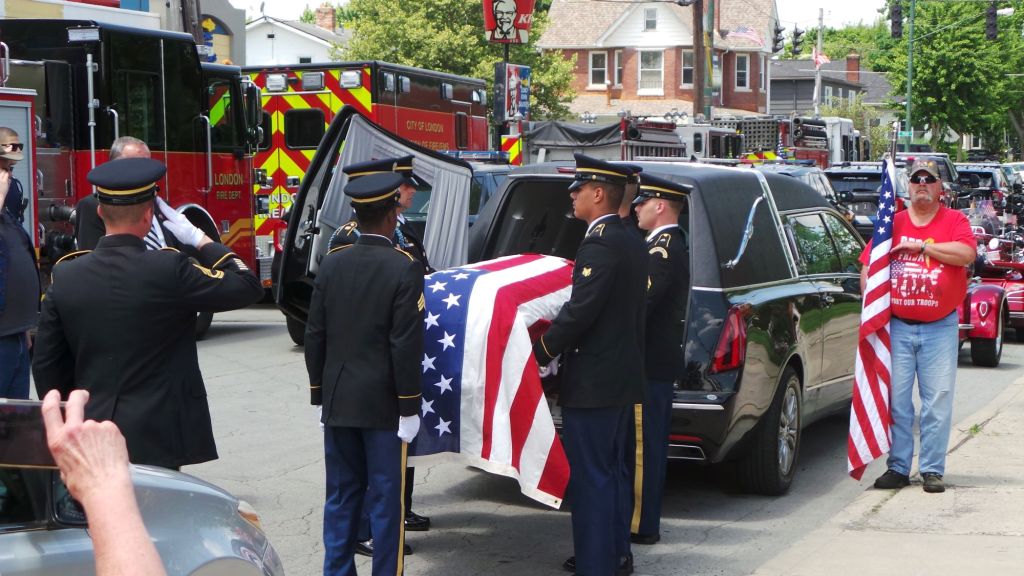
Saturday we honored a soldier who was killed in WW2 on a bombing run in Romania. His remains were identified last year and today he is brought home to rest in peace in Kirkwood Cemetery in London Ohio. He was a part of the 415th Bombardment Squadron (Heavy), 98th Bombardment Group (Heavy), 9th United States Air Force. The Defense POW/MIA Accounting Agency (DPAA) announced today that U.S. Army Air Forces 2nd Lt. James H. Marrah, 22, of London, Ohio, killed during World War II was accounted for August 3, 2023. In the summer of 1943, Marrah served with the 415th Bombardment Squadron (Heavy), 98th Bombardment Group (Heavy), 9th Air Force. On Aug. 1, 1943, the B-24 Liberator aircraft on which Marrah was serving as a co-pilot, crashed as a result of enemy antiaircraft fire during Operation TIDAL WAVE, the largest bombing mission against the oil fields and refineries at Ploiesti, north of Bucharest, Romania. His remains were not identified following the war. The remains that could not be identified were buried as Unknowns in the Hero Section of the Civilian and Military Cemetery of Bolovan, Ploiesti, Prahova, Romania. Following the war, the American Graves Registration Command (AGRC), the organization that searched for and recovered fallen American personnel, disinterred all American remains from the Bolovan Cemetery for identification. The AGRC was unable to identify more than 80 unknowns from Bolovan Cemetery, and those remains were permanently interred at Ar-dennes American Cemetery and Henri-Chapelle American Cemetery, both in Belgium. In 2017, DPAA began exhuming unknowns believed to be associated with unaccounted-for airmen from Operation TIDAL WAVE losses. These remains were sent to the DPAA Laboratory for examination and identification. To identify Marrah’s remains, scientists from DPAA used anthropological analysis, as well as circumstantial evidence. Additionally, scientists from the Armed Forces Medical Examiner System used mitochondrial DNA (mtDNA) analysis and autoso-mal DNA (auSTR). Marrah’s name is recorded on the Tablets of the Missing at the Florence American Cemetery, an American Battle Monuments Commission site in Impruneta, Italy, along with others still missing from WWII. A rosette will be placed next to his name to indicate he has been accounted for. Operation Tidal Wave Operation Tidal Wave was an air attack by bombers of the United States Army Air Forces (USAAF) based in Libya on nine oil refineries around Ploiesti, Romania on 1 August 1943, during World War II. It was a strategic bombing mission and part of the “oil campaign” to deny petroleum-based fuel to the Axis powers. The mission resulted in “no curtailment of overall product output”. This operation was one of the costliest for the USAAF in the European Theater, with 53 aircraft and 500 aircrewmen lost. It was proportionally the most costly major Allied air raid of the war, and its date was later referred to as “Black Sunday”. Five Medals of Honor and 56 Distinguished Service Crosses along with numerous other awards went to Operation Tidal Wave crew members. A 1999 research report prepared for the Air War College at Maxwell Air Force Base in Alabama concluded that the bombing campaign in Ploiesti was “one of the bloodiest and most heroic missions of all time”. One of the downed American planes crashed into a female prison in Ploiesti, resulting in about half of the civilian casualties from the total of 101 killed and 238 injured.

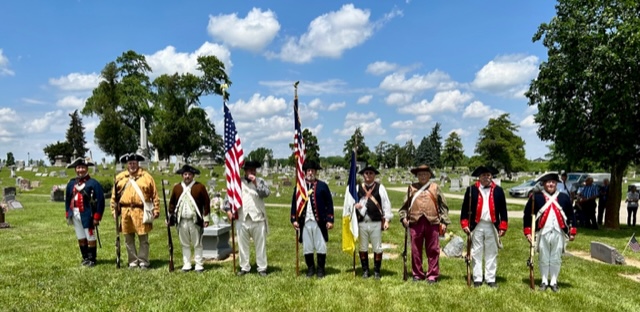


 Camp Charlotte Chapter #41-Sons of the American Revolution